The earlier a finding is noticed, the sooner it can be investigated.
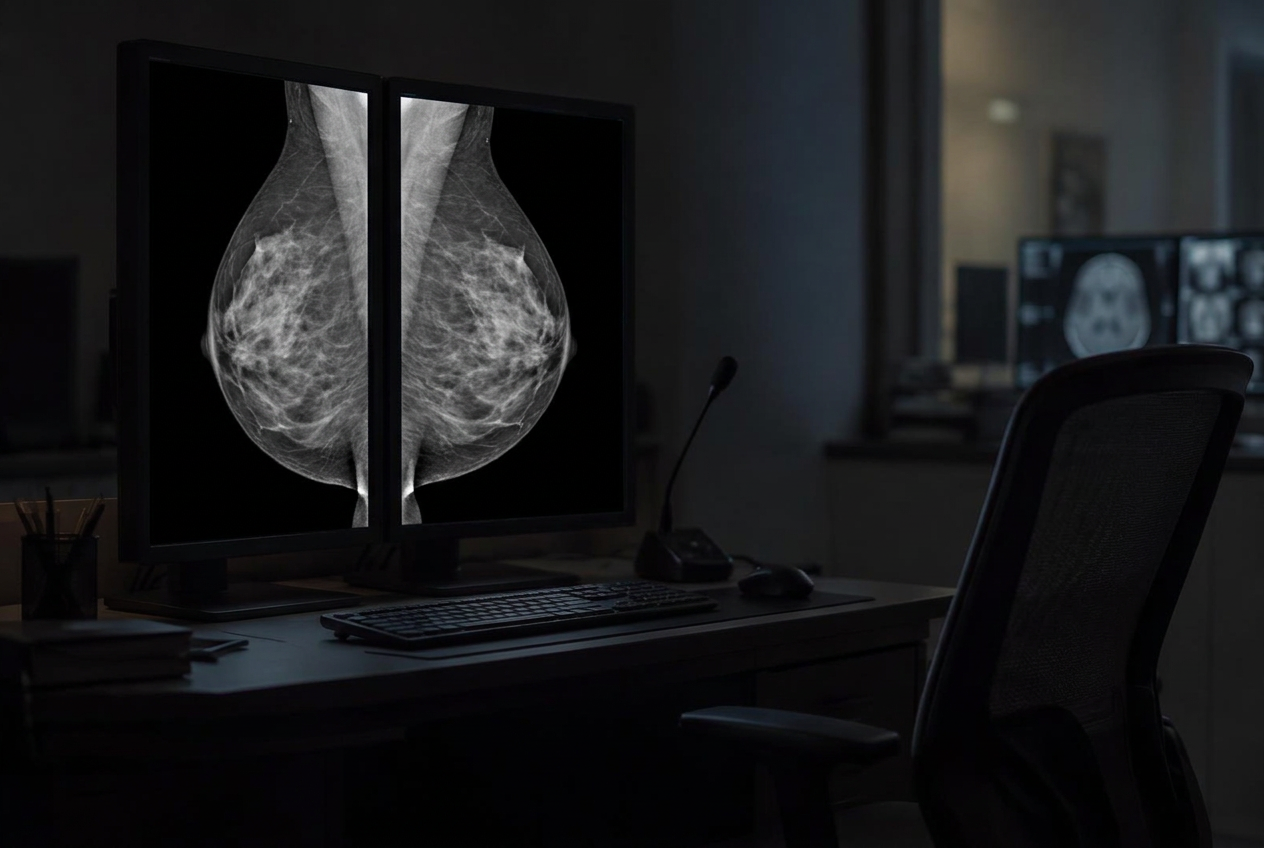
Breast cancer screening asks radiologists to review large volumes of images, spot subtle suspicious regions and compare them with prior examinations, while balancing detection against workload and recall rates.
This technology showcase explores an AI-assisted mammography workflow that helps radiologists direct their attention, without presenting model outputs as diagnoses.
- AI-Assisted Mammography
- Radiology AI
- Diagnostic Decision Support
01The Problem
Subtle findings. High volumes. Real trade-offs.
Most screening examinations are normal, so the important ones can be rare and subtle. Each case may involve several views and, where available, prior studies to compare against.
Any support tool has to be judged on more than speed. Fewer missed cancers, fewer unnecessary recalls and manageable reading workloads can pull in different directions.
Candidate regions · for radiologist review · illustrative
02What the Research Shows
Strong signals in research. Careful implementation in practice.
- Kelly et al. evaluated a mammography AI system retrospectively on 115,973 mammograms from five NHS screening services, then in a prospective, non-interventional feasibility deployment across 12 sites.
- In the retrospective study, the AI showed higher sensitivity than the first human reader with noninferior specificity, and no systematic demographic disparities were observed.
The remaining challenge
The prospective deployment confirmed technical feasibility but revealed a shift in the data that required the decision threshold to be recalibrated. The authors conclude that implementation needs adaptive calibration and continuous monitoring to stay safe and equitable.
A paired trial of 31,301 women found a partially automated AI strategy lowered radiologist workload and raised cancer detection, but the recall rate rose too and did not meet the noninferiority margin. Workload gains have to be weighed against recalls.
Supporting researchAI-based triage and decision support in mammography and digital tomosynthesis for breast cancer screeningElías-Cabot, Romero-Martín, Raya-Povedano et al. · Nature Medicine, 2026Findings belong to the cited research teams. sab.ai did not conduct these studies.
03Proposed Response
Highlight. Compare. Let the radiologist decide.
The proposed workflow makes findings easier to inspect. Every highlighted region is a prompt for expert review, never a diagnosis.
- 01
Intake and quality checks
Incoming images are checked for completeness and technical quality before analysis.
- 02
Candidate regions
Eligible mammography images are analyzed and regions worth a closer look are identified.
- 03
Annotation and comparison
Regions are shown as visual annotations, alongside available prior studies where appropriate.
- 04
Radiologist assessment
The radiologist confirms, dismisses or investigates each highlighted finding.
04Intended Value
Helping attention go where it matters.
The intended benefit is to help radiologists prioritize attention and investigate potentially important findings with clearer visual context.
Earlier detection, improved survival and reduced workload are not established outcomes of this design. Clinical validation and regulatory requirements depend on the intended use and deployment context.
05Evaluation
How it should be evaluated.
Evaluation should run on local data and keep running after deployment, as the published research shows performance can shift.
- Review time
- Sensitivity
- Specificity
- Recall rate
- False positives
- Subgroup performance
- External validation
06FAQs
Curious how it works?
Does the AI make the diagnosis?
No. This technology showcase describes a decision-support workflow. Highlighted regions are prompts for review; radiologists make every assessment.
Has this workflow been clinically validated?
No. It is a proposed design. Validation and regulatory requirements would depend on its intended use and deployment context.
Have a complex system that could work smarter?
Let's build what's next.
Case Studies
Our featured success stories.
Fintech
PulsePay
An intelligence and orchestration layer that connects payment operations without replacing the systems underneath. Target: up to 40% less time spent on manual payment investigations. Proposed target, not a verified result.
- Artificial Intelligence
- Payment Reconciliation
- Workflow Automation